

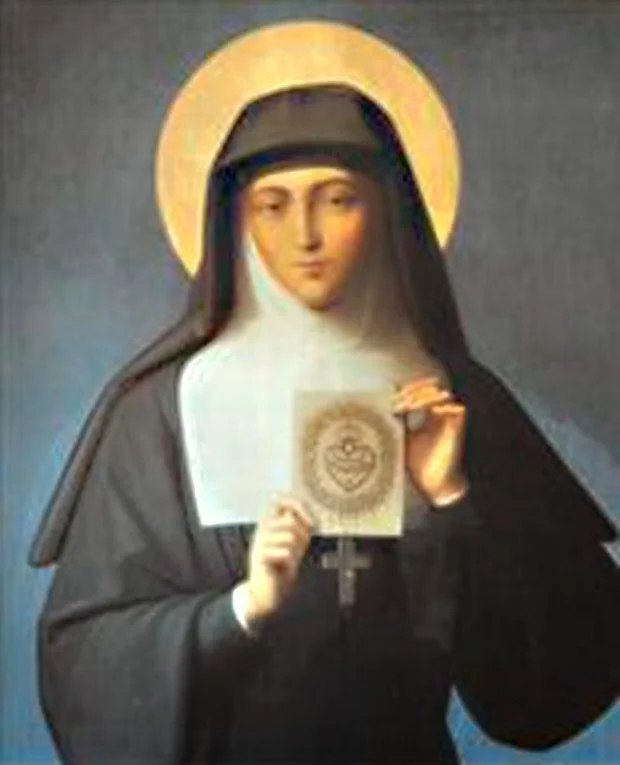
St. Margaret Mary Alacoque was a nun of the Visitation, and from her first Holy Communion at the age of seven, she had always manifested an intense love of the Most Blessed Sacrament. Our Lord appeared to her often, usually as the Crucified Christ. He revealed to her His Sacred Heart's burning desire to be loved by all men.

When, through inner struggles, a person succeeds in accepting concrete, unavoidable suffering as the will of God and sees in it the possibility of participating in the passion of Jesus, it does not mean that pain and sorrow are taken away. Although the pain must be borne, it is no longer senseless, and God's grace can work to transform the suffering so that the sufferer "rejoices in sorrow and exults in grieving love".

Bishop Thomas Struzzieri, the first Passionist bishop, said to Paul just before he breathed his last, "Father Paul, when you are in paradise, remember the poor Congregation for which you have toiled so hard, and all of us, your poor sons." With great fervor Paul made a gesture signifying Yes. Then he quietly closed his eyes and went to sleep in the Lord.

“The world lives unmindful of the sufferings of Jesus which are the miracle of miracles of the love of God. We must arouse the world from its slumber.” And so Paul did through thousands of letters he wrote and sermons he preached. Traveling even to marshlands infested with malaria, Paul taught people how to pray and meditate upon the suffering and death of Jesus.

Blessed Pius of Saint Aloysius, born Luigi Campidelli, was a religious and clerical student of the Passionist Congregation. He received Minor Orders but was struck down with tuberculosis before he could be ordained priest. He died at 21 years of age on November 2, 1889, offering his life for his troubled home region of Romagna.

Elizabeth’s spirituality of the Indwelling Trinity can be expressed by her words, “There is a being who is Love and who wants us to live in communion with Him.” She saw her life as an intimacy with the Father, Son, and Holy Spirit; heaven on earth, but in the darkness of faith.
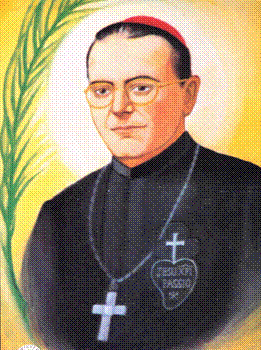
The Passionist Bishop and Martyr Eugene Bossilkov was born November 16, 1900 in Belene (Bulgaria), a village in the Danube Valley. He was executed in the prison (left) at Sophia on the night of November 11, 1952 at 11:30 P.M. His body was thrown into a common grave for criminals; the precise location of his burial place and his body is unknown.

Mother Mary Crucified was the superior of the first convent of Passionist Nuns. Through this role and because of her profound sharing in St. Paul's charism she is also called "co-foundress" of the Passionists. In 1982 Pope John Paul II approved the document declaring that she had practiced heroic virtue and should be called "Venerable." We await the day of her beatification!

Blessed Grimoaldo of the Purification, born Ferdinando Santamaria, a religious and clerical student of the Passionist Congregation, born on May 4, 1883 in Pontecorvo, Frosinone, Italy; died November 18, 1902 at Ceccano, Italy. Beatified by Pope John Paul II in 1995.

Some among the Jews offered them to God in their infancy, by the hands of the priests in the temple, to be lodged in apartments belonging to the temple, and brought up in attending the priests and Levites in the sacred ministry. It is an ancient tradition, that the Blessed Virgin Mary was thus solemnly offered to God in the temple in her infancy.

In the city of Rome there was a Christian virgin named Cecilia, who came from patrician family and was given in marriage to a pagan youth named Valerian. During her wedding ceremony she was said to have sung in her heart to God and before the consummation of her nuptials, she told her husband she had taken a vow of virginity and had an angel protecting her.

The Solemnity of Christ the King was established by Pope Pius XI in 1925 as an antidote to secularism, a way of life which leaves God out of man's thinking and living and organizes his life as if God did not exist. The feast is intended to proclaim in a striking and effective manner Christ's royalty over individuals, families, society, governments, and nations.

According to the New Testament, Andrew was born in the village of Bethsaida on the Sea of Galilee during the early first century. Much like his younger brother, Simon Peter, Andrew was also a fisherman. Andrew's very name means strong and he was known for having good social skills.
Local News Sites
Channel 14
Channel 25
Owensboro News
Owensboro Weather
World Wide News Sites
AP News
Fox News
EWTN News
Catholic News Agency
Catholic News Service
Spirit Daily
Ethics & Public Policy Center
C-Span
The Catholic Thing
First Things
Zenit
WorldNet Daily
Catholic Links
Catholic Culture–Liturgical Calendar
Divine Office Online
U.S. Bishops
EWTN
Vatican
Catholic TV
Telecare TV
Passionist International Website
On a human level, deep and authentic love yields not only true peace and contentment but also a desire to share the pain of the beloved. Immersion in the sufferings of Jesus and deep, interior intimacy with God were springs from which Paul's words flowed and which, to this day, contain a power that moves the hearts of people. This power is love.