Happy to be a Bride of Christ

Cloistered Nuns ~ Blogging?!


Why not? We thought this would be a wonderful way to make known the splendor of Passionist life.
God-willing more valiant women will join our monastic family through this peek into the cloister!

The Passionist Nuns vow to live in the light of the self-sacrificing love of Jesus. ~ Rule & Constitutions #12

Living under the gaze of His love...could God be calling you to dwell with us?

Annual Marian Procession

May 10th, 2012

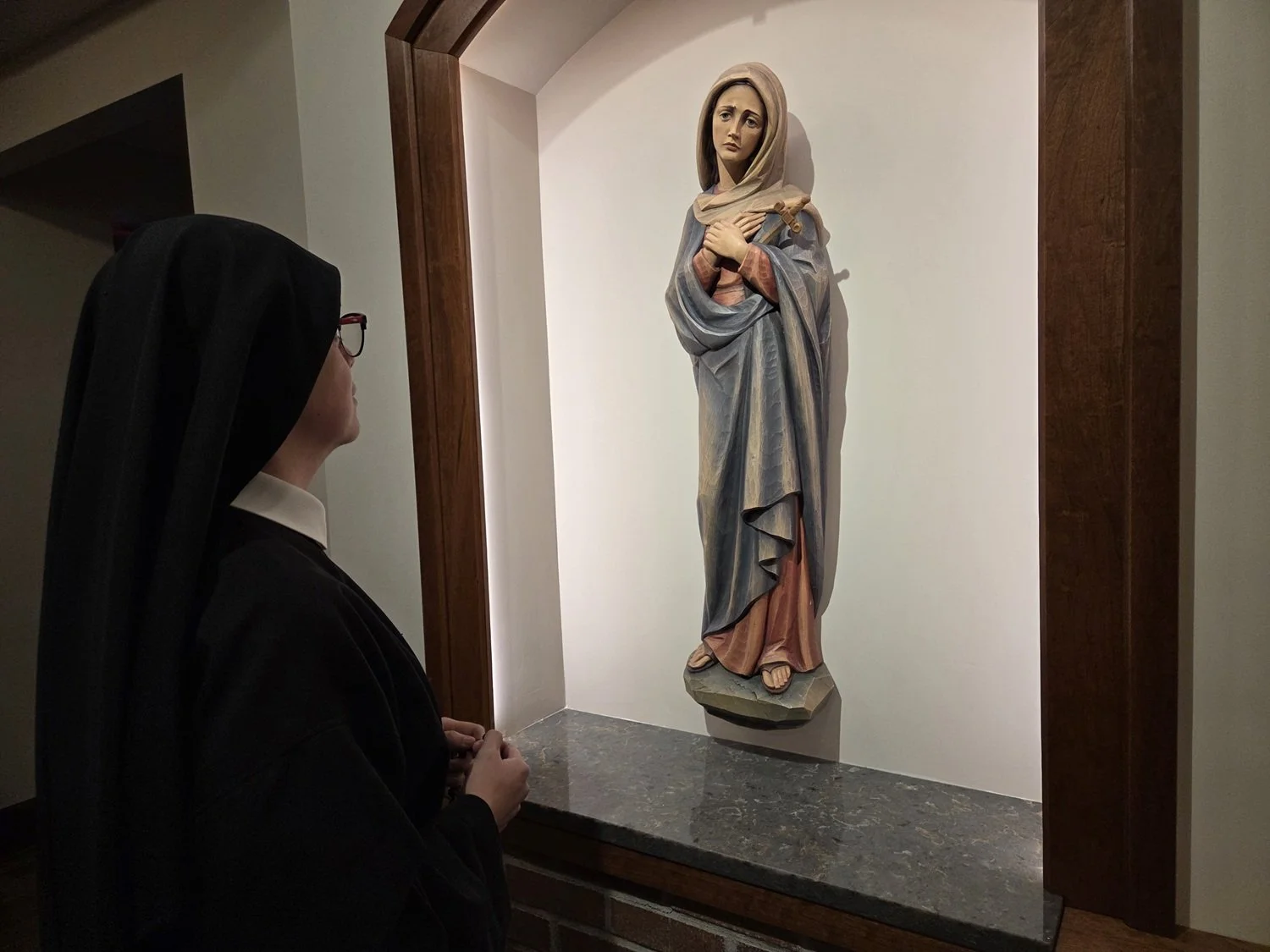
This past Sunday we had our community May Procession culminating in the Coronation of our Lady of Sorrows statue in the back of our monastery chapel.

During the procession a sister, chosen by lot, carries Mary’s crown of flowers as we sing hymns in honor of our Lady.

When we arrive in chapel we pray various prayers including a Consecration to the Immaculate Heart of Mary.

During the coronation hymn, a sister, chosen by lot, gets to crown our Lady’s image. This year, Sr. Cecilia’s name was drawn. What a privilege! Her name was also drawn when she was a postulant.

At the end of our devotion we pray the Litany of Loretto.

V. Lord, have mercy.

R. Christ have mercy.

V. Lord have mercy. Christ hear us.

R. Christ graciously hear us.

God the Father of heaven, have mercy on us.

God the Son, Redeemer of the world, have mercy on us.

God the Holy Spirit, have mercy on us.

Holy Trinity, one God, have mercy on us.


Holy Mary, pray for us.

Holy Mother of God, pray for us.

Holy Virgin of Virgins, [etc.]

Mother of Christ,

Mother of divine grace,

Mother most pure,

Mother most chaste,

Mother inviolate,

Mother undefiled,

Mother most amiable,

Mother most admirable,

Mother of good Counsel,

Mother of our Creator,

Mother of our Savior,

Virgin most prudent,

Virgin most venerable,

Virgin most renowned,

Virgin most powerful,

Virgin most merciful,

Virgin most faithful,

Mirror of justice,

Seat of wisdom,

Cause of our joy,

Spiritual vessel,

Vessel of honor,

Singular vessel of devotion,

Mystical rose,

Tower of David,

Tower of ivory,

House of gold,

Ark of the covenant,

Gate of heaven,

Morning star,

Health of the sick,

Refuge of sinners,

Comforter of the afflicted,

Help of Christians,

Queen of Angels,

Queen of Patriarchs,

Queen of Prophets,

Queen of Apostles,

Queen of Martyrs,

Queen of Confessors,

Queen of Virgins,

Queen of all Saints,

Queen conceived without original sin,

Queen assumed into heaven,

Queen of the most holy Rosary,

Queen of families,

Queen of peace,


V. Lamb of God, Who takest away the sins of the world,

R. Spare us, O Lord.

V. Lamb of God, Who takest away the sins of the world,

R. Graciously hear us, O Lord.

V. Lamb of God, Who takest away the sins of the world,

Have mercy on us.


V. Pray for us, O holy Mother of God.

R. That we may be made worthy of the promises of Christ.

Let us pray. Grant, we beseech Thee, O Lord God, that we thy servants may enjoy perpetual health of mind and body, and by the glorious intercession of blessed Mary, ever Virgin, may we be freed from present sorrow, and rejoice in eternal happiness. Through Christ our Lord. R. Amen.

Share on TwitterSubmit to StumbleUponShare via email

Recent Happenings at the Monastery

May 7th, 2012

“Where is everyone?” That was my thought Saturday morning when I came into chapel and saw that we had no guests for Mass, which is unusual. As I sat there praying and preparing to enter into the “Holy of holies” a number of people came in to chapel all at once.

During the announcements after the noon meal Sr. Mary Agnes explained to us what had happened. She had gotten a call before Mass stating that the gates were not open and there was a line of cars waiting to get through!

She drove down and discovered that the gate hinges had actually broken!  You can see here that the gate is being held to the post by a chain.  Our faithful grounds-keeper came over and with the tractor managed to move the gate so that our guests could come on in.

+++

On my walk down to take the photo of the gate I came upon the goose nest and it was empty…that could only mean one thing…the goslings were hatched and sure enough I snapped a photo of them here with mom and dad.

+++

Last week Anne and Chuck Hagan graciously delivered and spread some good “barn yard dirt” in the garden. God bless you!

+++

And Dave and Carol Niehaus (Sr. Mary Andrea’s parents) spent a day cutting down trees to provide more sunlight on the veggie garden. May God reward you for your labor!  Here a couple Sisters load up some of the cut wood.

+++

Today we had the great excitement of a shipment of compost arrive!  Good and rich compost – a whole dump truck full! Thank you Lord! and Jane & Tim Wynn! (Sr. Cecilia Maria’s parents)

Wow…who is going to spread all that?

:)

Who said monastery life was dull? Everyone has monotonous days but each moment of monotony is filled with graces that will not be given again.  May each of us respond to the Lord’s love and grace each moment of our days!

Share on TwitterSubmit to StumbleUponShare via email

Passionist Articles

May 2nd, 2012

Well…I can hardly believe it!

I created a widget in the side bar of this blog OVER A YEAR AGO called “Interesting Passionist Articles”, featuring PDF articles written by or about Passionist life in the Institute on Religious Life Magazine of September/October 2010.

Just last week it came to my knowledge that I linked to every one of those articles incorrectly! (Yes, I can believe I made this mistake) But I can’t believe that none of you, my dear friends, caught my mistake!

Please let me know if you find any other broken links on this blog site. I’ll gladly correct them if I can.

And I hope you’ll check out the articles in the side bar.

The Prefaces for Easter pray that we be “overcome with Paschal joy”…that is our prayer for you during this Eastertide!

Share on TwitterSubmit to StumbleUponShare via email

Scripture Sharing on Good Shepherd Sunday

April 30th, 2012


Scripture Reflection for the 4th Sunday of Easter

find these readings here at USCCB website.

Acts 4:8-12

Ps 118

1Jn 3:1-12

Jn 10:11-18

Sister Rose Marie started us out with a question this week. “What do you think St. John means when he says, ‘We shall be like [God], for we shall see Him as He is?’ It seems like he is saying that because we shall see Him, we shall be like Him.” Usually, as Sr. Mary Andrea pointed out, we think of it the other way around: we shall see God in heaven, because we will have been made like Him. Perfection in God’s image and likeness is the prerequisite for heaven, so to speak. But St. John turns it around. We shall be like Him, for we shall see Him as He is.

Her question started a glorious discussion about the power of God’s being. Sr. Cecilia Maria suggested that since God is Life Himself, so creative and regenerative in His very essence, perhaps merely being in His Presence changes us into Himself. Perhaps seeing God as He truly is, is a bit like standing by a fire: if you stand close enough, you become fire yourself! Our discussion continued: perhaps this is a hint at what Purgatory is. If when we die, we have not yet become like God, perhaps the sight of Him in all His Holiness, Power, and Beauty transforms us into His perfect likeness!

Sr. Mary Veronica had a beautiful suggestion: St. John may mean something more than physical sight here. “To see God” may well take on the deep implications of the Biblical “know,” implying profound communion between two beings. When we see God as He is, we will know Him, and that knowledge will by its very nature bring about the intimate communion of spousal love. Knowledge between God and the soul renders each into the other!

The other half of our sharing focused on our call to communion with Christ Jesus, our Good Shepherd. Sr. Cecilia Maria was captivated by Jesus’ statement, “I will lay down my life for the sheep…. No one takes it from me, but I lay it down on my own.” We are baptized into Christ, and we are called to the same reality, the same powerful and heroic choice! When I am hurt, when I suffer, when I must die to myself in the course of my day, I have a choice: I can be a victim and say, “woe is me,” or I can freely lay down my life for the sheep. Jesus looked like a powerless victim in His Passion, but He turned around and chose it. He chose to die for me and for the whole world. I must do the same! Our chaplain preached a beautiful homily on this call: we are all called to be Good Shepherds in our own lives; we are all called to lay down our life for the sheep entrusted to us. And as contemplative nuns, the whole world is the flock in our care!

Sr. Mary Andrea connected this reality with the psalm. “We bless you from the house of the Lord!” the psalmist sings. Since we are the house of the Lord by our baptism, we are called to be a blessing for the world wherever we are! We dwell in communion with Christ; we always and everywhere must live His life of redemption for the world.

Share on TwitterSubmit to StumbleUponShare via email

World Day of Prayer for Vocations 2012

April 26th, 2012

The 49th World Day of Prayer for Vocations will be observed this Sunday, April 29th, which is also known as “Good Shepherd Sunday.”  The purpose of this day is to publicly fulfill the Lord’s instruction to, “Pray the Lord of the harvest to send laborers into his harvest” (Mt 9:38; Lk 10:2).

Please pray that young men and women hear and respond generously to the Lord’s call to the priesthood, diaconate, religious life, societies of apostolic life or secular institutes. You can find many resources to promote a culture of vocations on the USCCB Facebook page for vocations.

+++

We have some super great news on the vocation front:

Please keep up your prayers for aspirant Anne. She was recently accepted to enter the postulancy. She is home now tying up loose ends and please God, will enter the monastery on Saturday, May 19th!

+++

Below is Pope Benedict’s Message for the
49th World Day of Prayer for Vocations:

Theme: Vocations, the Gift of the Love of God

Dear Brothers and Sisters,

The 49th World Day of Prayer for Vocations, which will be celebrated on 29 April 2012, the Fourth Sunday of Easter, prompts us to meditate on the theme: Vocations, the Gift of the Love of God.

The source of every perfect gift is God who is Love – Deus caritas est: “Whoever remains in love remains in God and God in him” (1 Jn 4:16). Sacred Scripture tells the story of this original bond between God and man, which precedes creation itself. Writing to the Christians of the city of Ephesus, Saint Paul raises a hymn of gratitude and praise to the Father who, with infinite benevolence, in the course of the centuries accomplishes his universal plan of salvation, which is a plan of love. In his Son Jesus – Paul states – “he chose us, before the foundation of the world, to be holy and without blemish before him in love” (Eph 1:4). We are loved by God even “before” we come into existence! Moved solely by his unconditional love, he created us “not … out of existing things” (cf. 2 Macc 7:28), to bring us into full communion with Him.

In great wonderment before the work of God’s providence, the Psalmist exclaims: “When I see the heavens, the work of your hands, the moon and the stars which you arranged, what is man that you should keep him in mind, mortal man that you care for him?” (Ps 8:3-4). The profound truth of our existence is thus contained in this surprising mystery: every creature, and in particular every human person, is the fruit of God’s thought and an act of his love, a love that is boundless, faithful and everlasting (cf. Jer 31:3). The discovery of this reality is what truly and profoundly changes our lives.

In a famous page of the Confessions, Saint Augustine expresses with great force his discovery of God, supreme beauty and supreme love, a God who was always close to him, and to whom he at last opened his mind and heart to be transformed:

“Late have I loved you, O Beauty ever ancient, ever new, late have I loved you! You were within me, but I was outside, and it was there that I searched for you. In my unloveliness I plunged into the lovely things which you created. You were with me, but I was not with you. Created things kept me from you; yet if they had not been in you they would have not been at all. You called, you shouted, and you broke through my deafness. You flashed, you shone, and you dispelled my blindness. You breathed your fragrance on me; I drew in breath and now I pant for you. I have tasted you, now I hunger and thirst for more. You touched me, and I burned for your peace.”

(X, 27.38)

With these images, the Saint of Hippo seeks to describe the ineffable mystery of his encounter with God, with God’s love that transforms all of life.

It is a love that is limitless and that precedes us, sustains us and calls us along the path of life, a love rooted in an absolutely free gift of God. Speaking particularly of the ministerial priesthood, my predecessor, Blessed John Paul II, stated that “every ministerial action – while it leads to loving and serving the Church – provides an incentive to grow in ever greater love and service of Jesus Christ the head, shepherd and spouse of the Church, a love which is always a response to the free and unsolicited love of God in Christ” (Pastores Dabo Vobis, 25). Every specific vocation is in fact born of the initiative of God; it is a gift of the Love of God! He is the One who takes the “first step”, and not because he has found something good in us, but because of the presence of his own love “poured out into our hearts through the Holy Spirit” (Rom 5:5).

In every age, the source of the divine call is to be found in the initiative of the infinite love of God, who reveals himself fully in Jesus Christ. As I wrote in my first Encyclical, Deus Caritas Est,

“God is indeed visible in a number of ways. In the love-story recounted by the Bible, he comes towards us, he seeks to win our hearts, all the way to the Last Supper, to the piercing of his heart on the Cross, to his appearances after the Resurrection and to the great deeds by which, through the activity of the Apostles, he guided the nascent Church along its path. Nor has the Lord been absent from subsequent Church history: he encounters us ever anew, in the men and women who reflect his presence, in his word, in the sacraments, and especially in the Eucharist”

(No. 17)

The love of God is everlasting; he is faithful to himself, to the “word that he commanded for a thousand generations” (Ps 105:8). Yet the appealing beauty of this divine love, which precedes and accompanies us, needs to be proclaimed ever anew, especially to younger generations. This divine love is the hidden impulse, the motivation which never fails, even in the most difficult circumstances.

Dear brothers and sisters, we need to open our lives to this love. It is to the perfection of the Father’s love (cf. Mt 5:48) that Jesus Christ calls us every day! The high standard of the Christian life consists in loving “as” God loves; with a love that is shown in the total, faithful and fruitful gift of self. Saint John of the Cross, writing to the Prioress of the Monastery of Segovia who was pained by the terrible circumstances surrounding his suspension, responded by urging her to act as God does: “Think nothing else but that God ordains all, and where there is no love, put love, and there you will draw out love” (Letters, 26).

It is in this soil of self-offering and openness to the love of God, and as the fruit of that love, that all vocations are born and grow. By drawing from this wellspring through prayer, constant recourse to God’s word and to the sacraments, especially the Eucharist, it becomes possible to live a life of love for our neighbors, in whom we come to perceive the face of Christ the Lord (cf. Mt 25:31-46). To express the inseparable bond that links these “two loves” – love of God and love of neighbor – both of which flow from the same divine source and return to it, Pope Saint Gregory the Great uses the metaphor of the seedling: “In the soil of our heart God first planted the root of love for him; from this, like the leaf, sprouts love for one another.” (Moralium Libri, sive expositio in Librum B. Job, Lib. VII, Ch. 24, 28; PL 75, 780D).

These two expressions of the one divine love must be lived with a particular intensity and purity of heart by those who have decided to set out on the path of vocation discernment towards the ministerial priesthood and the consecrated life; they are its distinguishing mark. Love of God, which priests and consecrated persons are called to mirror, however imperfectly, is the motivation for answering the Lord’s call to special consecration through priestly ordination or the profession of the evangelical counsels. Saint Peter’s vehement reply to the Divine Master: “Yes, Lord, you know that I love you” (Jn 21:15) contains the secret of a life fully given and lived out, and thus one which is deeply joyful.

The other practical expression of love, that towards our neighbor, and especially those who suffer and are in greatest need, is the decisive impulse that leads the priest and the consecrated person to be a builder of communion between people and a sower of hope. The relationship of consecrated persons, and especially of the priest, to the Christian community is vital and becomes a fundamental dimension of their affectivity. The Curé of Ars was fond of saying: “Priests are not priests for themselves, but for you” (Le cure d’Ars. Sa penséeSon cœur, Foi Vivante, 1966, p. 100).

Dear brother bishops, dear priests, deacons, consecrated men and women, catechists, pastoral workers and all of you who are engaged in the field of educating young people: I fervently exhort you to pay close attention to those members of parish communities, associations and ecclesial movements who sense a call to the priesthood or to a special consecration. It is important for the Church to create the conditions that will permit many young people to say “yes” in generous response to God’s loving call.

The task of fostering vocations will be to provide helpful guidance and direction along the way. Central to this should be love of God’s word nourished by a growing familiarity with sacred Scripture, and attentive and unceasing prayer, both personal and in community; this will make it possible to hear God’s call amid all the voices of daily life. But above all, the Eucharist should be the heart of every vocational journey: it is here that the love of God touches us in Christ’s sacrifice, the perfect expression of love, and it is here that we learn ever anew how to live according to the “high standard” of God’s love. Scripture, prayer and the Eucharist are the precious treasure enabling us to grasp the beauty of a life spent fully in service of the Kingdom.

It is my hope that the local Churches and all the various groups within them, will become places where vocations are carefully discerned and their authenticity tested, places where young men and women are offered wise and strong spiritual direction. In this way, the Christian community itself becomes a manifestation of the Love of God in which every calling is contained.

As a response to the demands of the new commandment of Jesus, this can find eloquent and particular realization in Christian families, whose love is an expression of the love of Christ who gave himself for his Church (cf. Eph 5:32). Within the family, “a community of life and love” (Gaudium et Spes, 48), young people can have a wonderful experience of this self-giving love. Indeed, families are not only the privileged place for human and Christian formation; they can also be “the primary and most excellent seed-bed of vocations to a life of consecration to the Kingdom of God” (Familiaris Consortio, 53), by helping their members to see, precisely within the family, the beauty and the importance of the priesthood and the consecrated life. May pastors and all the lay faithful always cooperate so that in the Church these “homes and schools of communion” may multiply, modelled on the Holy Family of Nazareth, the harmonious reflection on earth of the life of the Most Holy Trinity.

With this prayerful hope, I cordially impart my Apostolic Blessing to all of you: my brother bishops, priests, deacons, religious men and women and all lay faithful, and especially those young men and women who strive to listen with a docile heart to God’s voice and are ready to respond generously and faithfully.

 From the Vatican, 18 October 2011

BENEDICTUS PP. XVI

Share on TwitterSubmit to StumbleUponShare via email

Liturgy and Easter Egg Hunts

April 26th, 2012

This news is a few weeks late but better late than never!

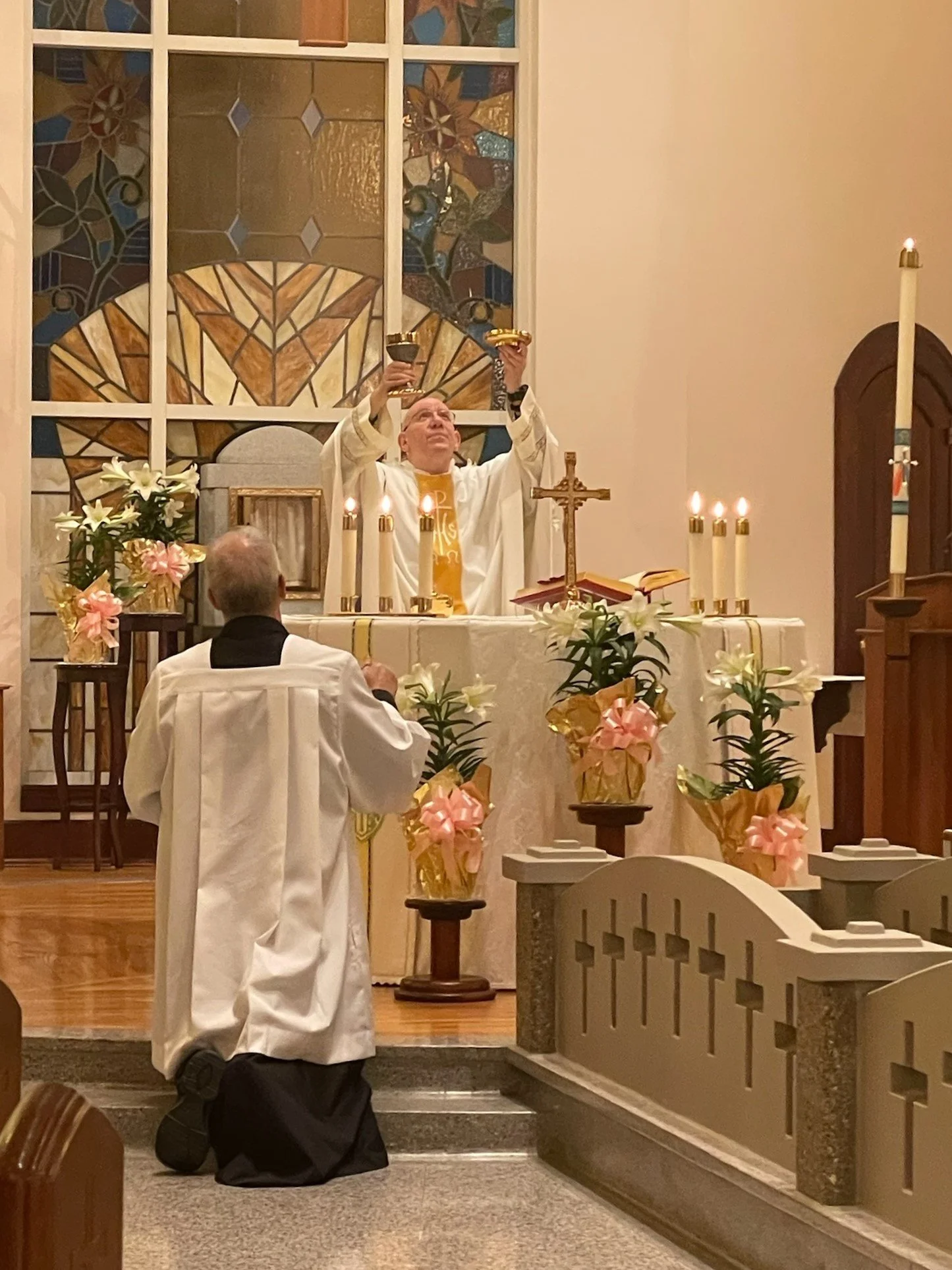
Here are a couple photos of our Mass on Easter Sunday morning:  special thanks to our servers of Holy Week!  And it was a joy to have seminarian David Gayhart with us who will be ordained to the transitional diaconate in a few months!

+++

I hope you are having a joyful Eastertide! We are. The Liturgy of Holy Week and Easter Week were so sacred and uplifting. On Easter Monday we had a mix of the spiritual and the mundane…The Exultet and an Easter Egg Hunt combined!

What do these have in common?  Nothing…so you might think…except when a group of two aspiring nuns in a monastery come up with a fun Easter game.

“2012 Eggsultet Hunt”

Sr. Cecilia Maria giving directions

  • two teams racing to be the first to put the Exsultet together
  • slips of paper with bits of text of the Exsultet are in eggs hidden in and outside the monastery

Sisters listen with full attention

Team #1

Nuns on the run…for eggs

Team #2

Sisters rest after the big hunt…

+++

Who won?

It was a tie! No lie!

+++

Too much Easter candy?

+++

A week later…

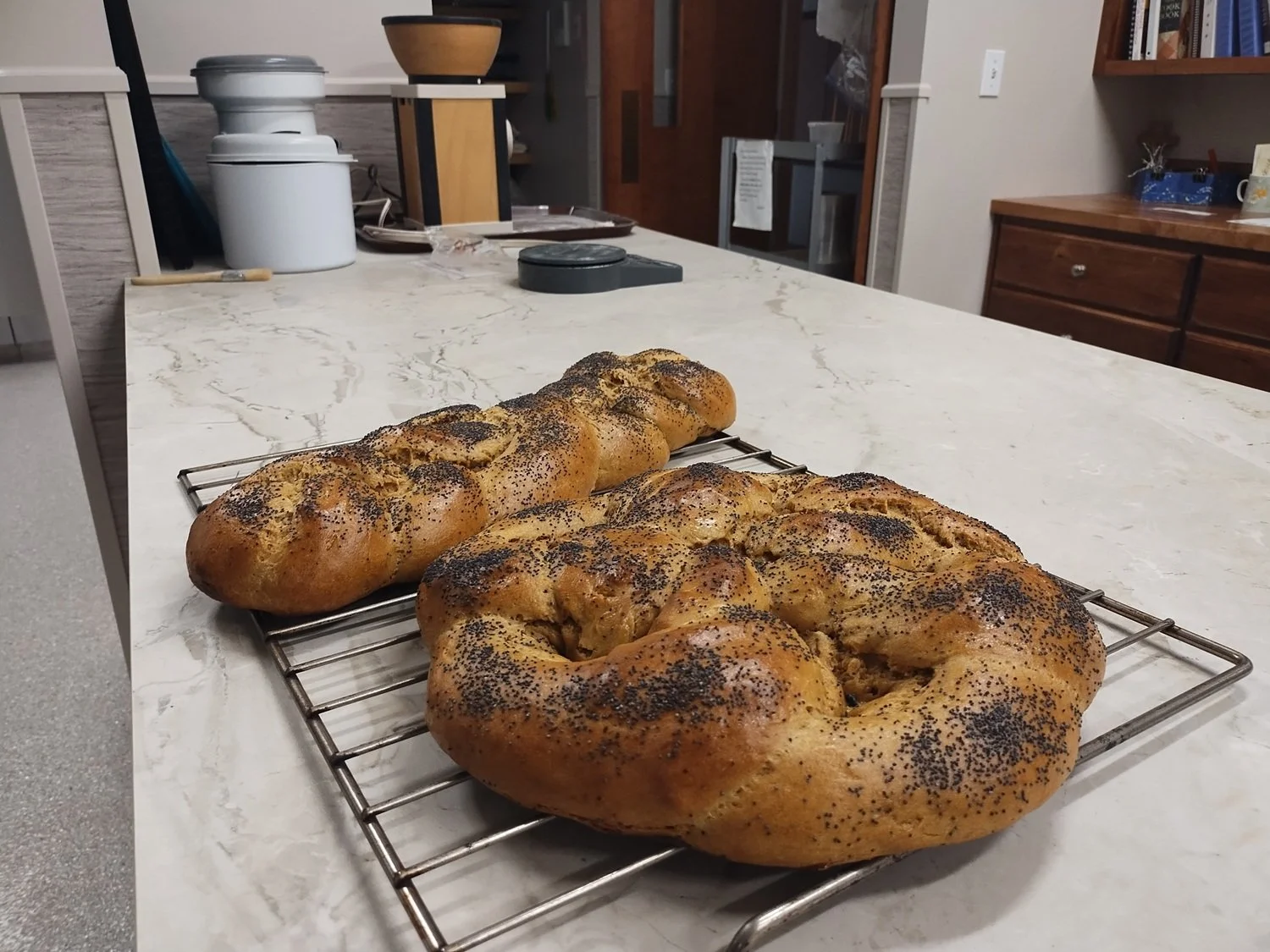
Sisters show off the last of our dyed eggs and hot cross buns

Divine Mercy Sunday
(If you look closely you can see the Divine Mercy Image
on the guests” side of the sanctuary.)

+++

*Wondering what the Exsultet is? It is an awesome hymn of praise sung before the Easter candle at the Easter Vigil.  Find out more here and here.

Share on TwitterSubmit to StumbleUponShare via email

Our Wounded Glorious Messiah

April 24th, 2012

Scripture Reflection for the 3rd Sunday of Easter

Acts of the Apostles 3:13-15, 17-19

Psalm 4:2, 4, 7-9

1 John 2:1-5

Luke 24:35-48

“Last week and this week I have been captivated by the fact that the risen Jesus is recognized and defined by the wounds of His crucifixion,” Sr. Cecilia Maria began as we reconvened for our Sunday Scripture discussion. In this week’s gospel, Jesus reassures His troubled disciples that it is truly he by showing them His pierced hands and feet. Last week, St. Thomas declared that he would not believe unless he saw and felt for himself the wounds left by the nails and the lance, and Jesus came to satisfy his desire.

What makes these scenes so remarkable is that none of the disciples, save St. John who was on Calvary, would have known the crucified Jesus. They knew Him by His voice, miracles, walk, visage. Yet He shows them His wounds, and by them they recognize and believe in Him. “See my hands and my feet, that it is I myself!” Why? Why the wounds?

Sr. Mary Veronica phrased the mystery this way: God chose to retain and glorify the wounds of His shameful and bloody crucifixion. He didn’t have to. He could have wiped them away entirely, just like He could have avoided the Passion in His work of salvation. But He didn’t. He suffered, and He chose to remain wounded even in His glory for all eternity (as Sr. Mary Andrea reminded us).

Jesus Christ – and therefore God, who is Love Himself – chose to be defined by His wounds. This should give us great hope and consolation! God did not only enter into our suffering, but He made it a part of Himself and then glorified it.

This means that we can meet God even and especially in the parts of our life that hurt the most, the wounds of our own existence. This gives an extraordinary dimension to our own resurrection and eternal life. In heaven, God will not remove from us our wounds from physical, emotional, psychological, spiritual sufferings. No, but He will glorify them! Our ugliest sufferings and trials will, in Christ, become the most beautiful parts of us, just like Christ’s glorious wounds shine with the brightest radiance.

Sr. Rose Marie helped us to see the consolation and assurance Christ’s wounds gave to the apostles, and that they can give to each of us. What was the disciples’ reaction to Jesus as he appeared and said to them, “Peace be with you?” They were startled, terrified, troubled, questioning, incredulous, amazed! And for good reason: the vast majority had abandoned or denied Him, and they were cowering from fear of joining Him in His fate. Seeing Him alive would have confirmed their earlier conviction that He truly is the Messiah of God…and God’s people had killed Him. Surely they were thinking in their hearts, “What will He say now? What will He do now? We are in trouble. We blew it.” But Jesus comes with peace, and the assurance: look at my hands and my feet, and know that “it is written that the Messiah would suffer.” This was planned, and I did it for you! Peace be with you.

May we each discover the peace that flows from Christ’s glorious wounds! May we recognize Him in them, and may we discover, as Sr. Rose Marie stated so poignantly, that Christ’s wounds mark the way to heaven.

Share on TwitterSubmit to StumbleUponShare via email

Cultivating a Sense of Humor

April 23rd, 2012

Three blog posts in 3 days! I am on a roll…or actually, I am on retreat and have time to type up some posts that have been rolling around in my head…

+++

Have you checked your humor lately?

How is it doing?

Two things my spiritual director persistently (!) speaks about is my need to grow in humility and my need to develop a sense of humor.

This past Christmas we received a delightful gift from Sr. Cecilia Maria’s grandmother that is helping me with the latter point, a book called Between Heaven and Mirth by Fr. James Martin, SJ. In this book Father assures us that God wants us to experience joy, to cultivate a sense of holy humor, and to laugh at life’s absurdities – not to mention our own humanity.  I invite you to rediscover the importance of humor and laughter in your daily life…and so does Pope Benedict!

I believe [God] has a great sense of humor. Sometimes he gives you something like a nudge and says, ‘Don’t take yourself so seriously!’ Humor is in fact an essential element in the mirth of creation. We can see how, in many matters in our lives, God wants to prod us into taking things a bit more lightly; to see the funny side of it; to get down off our pedestal and not to forget our sense of fun.

~Pope Benedict XVI – In God and the World

By the way, Anita (Grandmother!) recently came with Sr. Cecilia Maria’s parents for a visit. They kept speaking of the physical resemblance between her and Sr. Mary Magdalen. You decide…

Do you like Anita’s amber necklace? This “petrified tree sap” washes up on the shores of Denmark where Anita is from.

Share on TwitterSubmit to StumbleUponShare via email

May 1st – Evening of Prayer for Our Nation

April 22nd, 2012

That’s right. In 9 days we will host our 3rd Evening of Prayer for our Nation in anticipation of our national presidential elections in November.

Fr. Tony Stephens, Vocation Director for the Fathers of Mercy will be here to lead us in prayer and to exhort us to holiness. Please invite some friends and bring your family.

Tuesday, May 1st, 6:30 – 8 p.m.

Exposition of the Blessed Sacrament, Rosary, Divine Mercy Chaplet, Consecration of our Nation to the Sorrowful and Immaculate Heart of Mary,  Solemn Benediction and more.

Please join us in praying for our beloved nation!

Share on TwitterSubmit to StumbleUponShare via email

The Monastic Cell

April 21st, 2012

Please keep us in your prayers…

Half of the Sisters are in 8-day solitude retreat while the other half take on the extra duties.

During Lent I read a delightful book about one of my fellow contemplatives: He Is My Heaven: The Life of Elizabeth of the Trinity by Jennifer Moorcroft. Mrs. Moorcroft – wonderful job!  This is the 2nd time I have read this book since we received it as a gift for my Final Profession of Vows in 2003. If you like our blog you will LOVE this book!

Anyway, Elizabeth waxes eloquent about the spirituality of the cell and Mrs. Moorcroft quotes some of her letters. During my retreat I am spending more time in my cell…reading, praying, studying, crocheting, resting. It is good to be in solitude with the Beloved. Here is what Blessed Elizabeth has to write about it:

…it is filled with God and I spend such wonderful hours there alone with the Bridegroom. For me, the cell is something sacred, it is His intimate sanctuary, just for Him and His little bride. We are so much “together,” I am silent, I listen to Him…it is so good to hear everything He has to say. And I love Him while I ply my needle and work on this dear serge (her habit) that I have so longed to wear.

Our cells are plain, sparsely furnished mostly with donated or homemade furniture and absent of superfluities. This gives them an austere beauty and a visual peace. It is the outward embodiment of the inner cell we live in while in the state of God’s abundant grace. I must admit though, sometimes I have so many books on my desk that I can’t find the desk!  I have a little prayer altar where I keep a holy image, a candle and a notebook of prayer intentions, some holy relics and a blessed palm.

We find God in everything – by Faith. We live him, breathe him, love him – by Faith. Especially in the solitude of the cell.

Share on TwitterSubmit to StumbleUponShare via email

Next »